
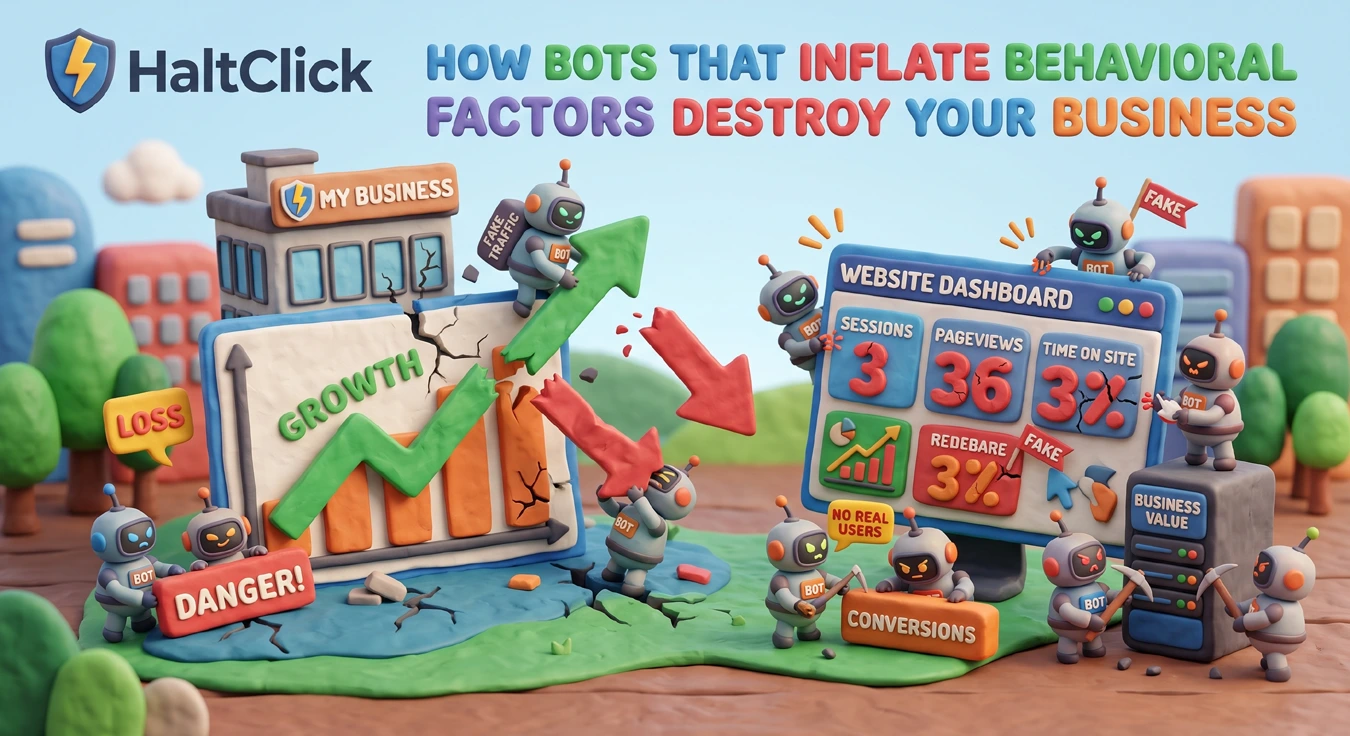
Parasitic traffic, bot nurturing, and click fraud are the three pillars of digital fraud. Let's break down how it works.
Imagine you open Yandex.Metrica, see a 40% increase in visits, get excited, and a month later your site's rankings crash by 20–30 positions. Sound familiar?
You are not alone. In 2025, malicious bots accounted for 37% of all internet traffic, and the total volume of automated traffic exceeded human traffic for the first time, reaching 51%. This means that more than half of all visitors to your site may not be people.
I have been working with contextual advertising and SEO for over ten years, and in that time I have never seen a bot problem solve itself. It only gets worse: bots are getting smarter, search engine algorithms more complex, and protection tools that worked a couple of years ago are useless today.
Let's figure out:
- how behavioral factors affect ranking and why bots love to inflate them;
- what bot «nurturing» is and why your site can suffer even without direct attacks;
- how to distinguish bot traffic from human traffic (spoiler: it's harder than it seems);
- which protection methods really work and which only create the illusion of security;
Chapter 1. Behavioral Factors: Why Search Engines Are Obsessed with Them
1.1. What behavioral factors are and why search engines need them
Behavioral factors (BF) are a set of metrics that describe how users interact with your site. Search engines use them as one of the key quality signals.
The algorithms responsible for analyzing BF have their own names:
- in Yandex — «Korolyov»;
- in Google — Navboost.
Both algorithms focus on the same basic metrics, although they interpret them differently.
Key internal behavioral factors:
| Metric | What it measures | Why it matters |
|---|---|---|
| Time on site | How many seconds/minutes a user spends on the resource | The longer, the more likely the content is relevant |
| Bounce rate | % of users who left the site after one page | High bounce = mismatch with expectations |
| Page depth | How many pages a user views per visit | More pages = higher interest in content |
| Return rate | How often a user returns to the site | Loyal audience = quality resource |
External behavioral factors:
- Snippet CTR — the percentage of users who clicked on your result in the SERP;
- Return to search — the user went to the site and almost immediately returned to the SERP (bad signal);
- Direct visits — the user manually enters the URL or uses a bookmark (excellent signal).
In 2025, both Yandex and Google have moved into a «behavioral depth» mode: they analyze not just the fact of a click and a return, but build full behavioral portraits of users. This means that primitive imitation no longer works — you need to reproduce complex patterns.
1.2. How much weight do BF have in ranking
According to some estimates, behavioral metrics account for up to 30% of the weight in ranking algorithms. In Yandex's commercial search, their influence is even higher.
In 2025, there was a data leak about 1,922 Yandex ranking factors, which use more than 17,000 signals. Behavioral factors are one of the largest groups in this system.
Chapter 2. How Bots Inflate Behavioral Factors (and What Your Site Has to Do with It)
2.1. The technology of inflation: from A to Z
Behavioral factor inflation is the process of artificially improving site metrics using bots or hired performers. The typical bot workflow for BF inflation looks like this:
Getting queries
The bot receives a list of queries for which it needs to simulate search.
«Nurturing» the profile
Step by step, it enters queries, clicks on results (and ads), collects cookies and fingerprints.
Visiting the site
After nurturing, the bot visits the target site for a specific query.
Imitation
Scrolls the page, moves the mouse, «reads» text, fills out forms.
Key point: the nurturing stage is the most important. Without it, the bot is easy to detect. With it, it is almost indistinguishable from a human.
2.2. What bot «nurturing» is and why it is dangerous for your site
Nurturing is the process of «training» a bot, during which it:
- creates a search history for the required keywords;
- accumulates cookies and digital traces (fingerprints);
- clicks on various sites in the SERP, including yours, if you are in the top for that query.
And here lies the main danger: even if you did not order the inflation, your site can become a «training ground» for bots. Bots visit you, stay for 15–30 seconds, and leave. The search engine sees this as a bounce. Bounces increase. Rankings drop.
In professional circles, this is called «the echo of BF inflation» or «collateral damage.»
«Profile nurturing is part of negative inflation. At this stage, the profile of a bot user is formed through simple visits to various sites. Then the bot enters the target site already with good BF.»
2.3. Types of bots for BF inflation
| Bot type | Description | Detection difficulty |
|---|---|---|
| Script bots | Simple scripts that imitate HTTP requests | Low |
| Browser emulators | Emulate a full browser (Puppeteer, Playwright) | Medium |
| Headless browsers | Work without a graphical interface but with full JS support | High |
| AI bots | Use machine learning to imitate human behavior | Very high |
Bots are getting smarter every year. Imperva notes that most modern malicious bots are built using AI, making them faster, more evasive, and harder to detect.
Chapter 3. Signs of Bot Activity: How to Know Your Site Is Under Attack
3.1. Visual signs in Metrica and Webvisor
An experienced marketer will notice bots even without special tools. Here are the key markers:
1. Abnormal growth of direct visits
Traffic has sharply increased, but mainly due to direct visits or transitions from social networks. At the same time, search traffic has remained at the same level or dropped.
2. Strange behavior in Webvisor
- Scrolling is too fast or too slow;
- Mouse movements are chaotic, clicks in empty areas;
- The «visitor» stops on sections without meaningful text;
- Sessions last exactly 15–30 seconds (the minimum time to not be counted as a bounce).
3. Technical anomalies
- All «visitors» use the same screen resolution;
- Mass visits from mobile operator IPs (especially Moscow and the Moscow region);
- Missing or non-standard User-Agent.
3.2. Quantitative signs
| Sign | Normal | Alarm signal |
|---|---|---|
| Share of bot traffic | up to 15–20% | > 30–40% |
| Bounce rate | 20–40% (depends on niche) | Sharp drop or rise > 15% in a week |
| Average time on site | 1–3 minutes | Sharp drop to < 30 seconds |
| Page depth | 2–4 pages | Sharp drop to 1–1.5 pages |
Important: one or two signs may be random. A system of signs is a reason for a deep audit.
3.3. Why Yandex.Metrica does not always help
Yandex.Metrica can detect search engine robots, but it does not identify «malicious» bots that imitate human behavior.
Moreover, recently Yandex has started marking even real visitors as robots:
- users in incognito mode;
- owners of outdated browsers;
- visitors with atypical behavior.
This creates a false sense that the problem is solved, while in reality bots continue to attack.
Chapter 4. Consequences: What Happens to an Unprotected Site
4.1. Drop in SERP positions
The algorithm concludes: the content is not relevant to the query. Positions drop. For some queries, pages can go far beyond the TOP-100.
4.2. Loss of organic traffic
Drop in positions = drop in traffic. If bot traffic exceeds organic, the search engine may decide that you are inflating BF yourself.
4.3. Search engine filters
AGS, Baden-Baden. Getting under a filter is a toxic status for a domain for a long time. Sometimes forever.
4.4. Advertising problems
Bots accidentally or deliberately click your budget. From 14% to 22% of the budget can be wasted. In competitive niches — up to 40%.
Chapter 5. Bot Protection: What Works and What Doesn't
5.1. Traditional methods (and their drawbacks)
IP blocking
IPv6 blocking
Cloudflare JS Challenge & Captcha (effectively unavailable in Russia since 2025)
5.2. Modern antibot solutions
The antifraud market is actively growing. Specialized services are emerging that analyze hundreds of parameters and make decisions in fractions of a second. What a modern antibot should be able to do:
- analyze behavioral patterns (mouse movement, scrolling, clicks);
- check digital fingerprints (canvas, WebGL, audio context);
- track technical parameters (User-Agent, screen resolution, installed fonts);
- work before the site loads, so that the bot does not even reach the page;
- allow search engine robots without delays.
Chapter 6. HaltClick: Two in One — Antibot + Click Fraud Protection
6.1. Uniqueness of the approach
Most services solve only one problem: some protect against bots, others against click fraud. HaltClick is the exception. It is a single solution that:
Blocks bots at the entrance
Before they load your site. The script checks for humanity, and if it's a bot, it does not even get to the page. Server load is reduced by 3–5 times.
Marks bots in analytics
All suspicious visits are tagged. You can create segments in Yandex.Metrica and Google Analytics and exclude them from ad campaigns.
Protects the advertising budget
Bots that still get through the antibot shield (e.g., AI emulators) are tracked and blocked at the level of advertising systems.
6.3. Real savings figures
6.4. Why HaltClick and not analogs
| Criterion | HaltClick | Typical competitors |
|---|---|---|
| Antibot at entrance | ✅ Yes | Partially |
| Click fraud protection | ✅ Yes | Only in specialized ones |
| Ready-made segments for Metrica/GA | ✅ Yes | Rarely |
| Single script for everything | ✅ Yes | No (need 2-3 services) |
Chapter 7. Practical Case: How We Saved a Site from the «Echo of Inflation»
All data is anonymized, but the situation is real.
Initial data:
- Online building materials store, 5 years on the market;
- Monthly traffic: 45,000 visits;
- Contextual advertising budget: 180,000 ₽/month;
- Positions on top 10 queries: stable TOP-5.
Problem:
Within 2 months, positions on 7 out of 10 key queries dropped by 15–25 points. Search traffic decreased by 40%. At the same time, total traffic increased by 25% due to direct visits.
Diagnostics:
- In Webvisor — mass sessions of 15–20 seconds with chaotic scrolling;
- 80% of «direct» visits — from mobile operator IPs;
- Bounce rate rose from 28% to 47% in a month.
Diagnosis: bots were nurtured to inflate BF on a third-party site, and our client became the «middleman.»
Solution:
- Installed the HaltClick antibot.
- Configured segments in Metrica to exclude bot traffic.
- Made adjustments to advertising (excluded segments).
Result after 3 months:
- Bot traffic decreased by 85%;
- Bounce rate returned to 29%;
- Positions recovered to the original level (5 out of 7 queries);
- Advertising budget savings: 34,000 ₽/month.
Chapter 8. What to Do If You Are Already Under Attack: A Step-by-Step Plan
Audit
Check Metrica by the following parameters:
- «Robots» report — how much traffic is marked as bot;
- «Popular pages» report — is there a sharp growth on low-frequency pages;
- Webvisor — look at 20–30 random sessions for anomalies.
Filtering
Temporarily disable bot traffic accounting through a filter by IP or source.
But remember: this is a temporary measure. Permanent filtering through Metrica is a crutch, not a solution.
Protection
Connect a professional solution. HaltClick is the optimal option:
- installation takes 5 minutes;
- protects the site from junk visits;
- provides ready-made segments for advertising.
Recovery
If positions have already dropped: update content, add pages, strengthen the link profile with quality links.
Important: if the drop was caused by bots, positions will start recovering within 2–4 weeks after connecting protection.
Chapter 9. Frequently Asked Questions
Will the antibot affect SEO?
Will real visitors see the verification page?
Is there a free plan?
How exactly do bots get into Metrica segments?
Protection is not an expense, but an investment
Bots are not just an annoying nuisance, but a real threat to your business:
- they steal the advertising budget;
- they destroy SEO positions;
- they distort analytics;
- they load servers;
- they create fake leads, wasting managers' time.
Ignoring this threat means allowing competitors and fraudsters to use your resources for free.