
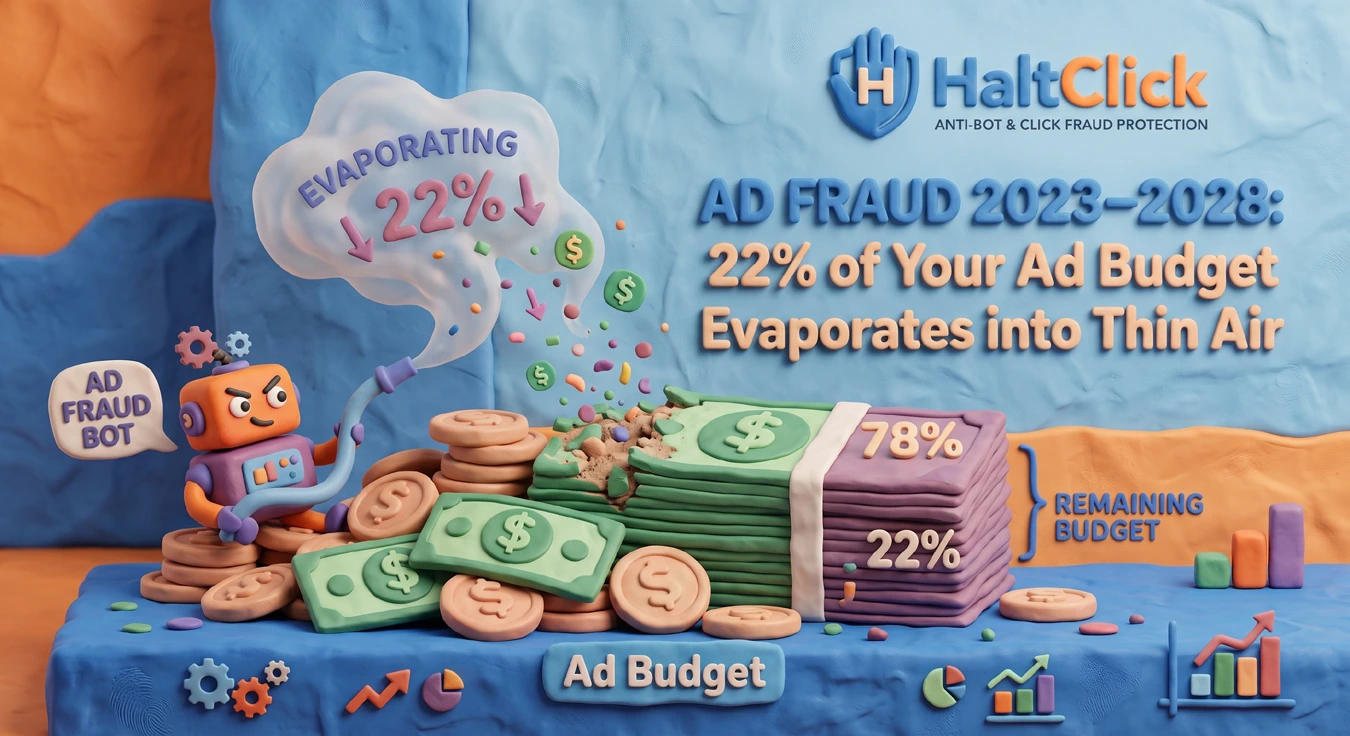
Analysis of the Juniper Research report «Quantifying the Cost of Ad Fraud: 2023-2028» ↗ Hard facts for advertisers who want to understand where their money actually goes.
Instead of a preface: numbers that make you want a drink
Do you know what digital marketing and gambling have in common? In both cases, you bet money hoping to win, while someone behind the scenes has long since skimmed the cream and is preparing a new trick to leave you empty-handed. Only unlike a casino, where at least probability theory exists, in the world of advertising traffic you are methodically robbed 24/7, and you don’t even notice it until you look at an empty conversion report.
Juniper Research is not some shady outfit making predictions on the back of a napkin. It is an analytical center that has been monitoring digital ecosystems with surgical precision since 2001. And their report «Quantifying the Cost of Ad Fraud: 2023-2028» is not just a collection of dry numbers; it is a medical diagnosis for the entire digital advertising industry. A diagnosis that says: you are losing 22% of your advertising budget to outright fraud, and by 2028 that figure will grow to 23%.
Let’s skip the euphemisms. We are talking about $84.2 billion in 2023. By 2028 — $172.3 billion. This is not simply «ineffective spending.» This is money you are handing over to fraudsters. Whether you realize it or not doesn’t matter. What matters is that it can and should be prevented.
And today we are going to break down this report the way every self-respecting advertiser should read it. No rose-colored glasses. No «we have everything under control.» Just numbers, facts, and hard conclusions.
Numbers you cannot ignore
Loss dynamics: catastrophic growth accelerating every year. This is not inflation; it is the exponential development of fraud technology.
§1 What ad fraud is and why it concerns you personally
A definition that makes you uneasy
Juniper Research gives a crystal-clear definition: «The illegal act of deliberately repeatedly clicking on PPC ads in order to artificially inflate traffic statistics and generate revenue for illegitimate sources while simultaneously reducing return on investment for advertisers.»
Let me translate that into plain language. Someone is sitting there methodically clicking your ads. Not because they are interested in your product. But because every click moves money from your pocket into the pocket of a publisher or a fraudulent network.
But the scariest part is not even that. The scariest part is that you cannot tell the difference between a real user and a bot unless you use specialized tools. Google and Facebook give you a rosy picture that does not distinguish legitimate clicks from click-farm clicks. You look at the report and rejoice at a high CTR, not suspecting that 17% of desktop clicks are worthless.
Types of fraud: not all bots are equally harmful
Clickbots
Programs that imitate the behavior of real users. As a result, advertisers suffer, directly losing budget to untargeted click fraud.
Botnets
Networks of thousands of infected devices with different IP addresses around the world. Platforms are often unable to detect such distributed anomalies.
Click farms
Organized groups (formerly people, now mostly bots) that cause systemic damage to all participants in the advertising chain.
SIVT
Sophisticated Invalid Traffic — complex invalid traffic using AI. It deceives even the most experienced advertisers and built-in algorithms.
Botnets deserve special attention. They are not just one computer with a clicker program. You try to block one IP — and there are thousands of them. You update filters — they update tactics. It is a war of attrition, and without serious weapons you are losing.
§2 Dynamics and mobile fraud
The total number of legitimate clicks will grow from 160 billion in 2023 to 235 billion in 2028. But fraudulent traffic will grow even faster — from 37 to 65 billion clicks. The ratio is relentlessly worsening.
This is where the real bomb is. In-app advertising is the fastest-growing segment (from $203.8 billion to $479.4 billion by 2028). And it is precisely this segment that will become the main target. The forecast says: in-app advertising will generate 52% of all global fraud losses by 2028. Where the money is, fraud follows.
§3 Attack channels: where you are hit hardest
Video advertising: $4 billion from Google alone
YouTube found itself at the center of a scandal: the company placed ads in small, muted video players that nobody watched. The result? $4 billion in advertising budgets lost in 2023 alone. If the giants «mess up» and violate their own policies, what can be said about smaller networks?
Search advertising and social media
Search advertising will become the leader in fraudulent activity over the next five years (in part due to auto-playing video ads in a loop without user interaction). The social media market is an oligopoly. Fraudsters only need to focus on a few major platforms to generate targeted fraudulent campaigns that damage the ROAS of thousands of advertisers.
§4 AI: a double-edged weapon in the devil’s hands
«SIVT uses AI to actively avoid detection by AI-based fraud mitigation frameworks, creating a cat-and-mouse game involving adversarial AI and resulting in a lack of return on investment for advertisers.»
Artificial intelligence has become a weapon. Fraudsters use AI to create bots and malware that can mimic human behavior. ChatGPT and other algorithms make it possible to program bots that imitate mouse movements, time between clicks, and scroll patterns.
«The data generated by digital advertising platforms such as Google and Facebook is often not sophisticated enough...» The built-in analytics of platforms is an illusion of protection. Their business is selling you advertising, not protecting you from fraud.
§5 Solutions: third-party tools
Juniper Research is unambiguous: advertisers must implement third-party data analysis tools. Only these tools can use machine learning and AI to compare behavior against verifiable baselines.
Detection methods
- Invalid click monitoring: Tracking anomalies
- IP monitoring: Tracking suspicious addresses
- VPN detection: Identifying proxy traffic
- Geolocation tracking: Detecting mismatches
Prevention methods
- Device blocking: Preventing repeated attacks
- Fraud scoring: Assessing the risk of each click
- Blacklisting: Adding fraudsters to blacklists
Fraud-fighting platforms will return more than $23 billion in lost ad spend to advertisers in 2023 (and $47 billion by 2028). Small and medium-sized businesses are especially at risk: maximizing ROAS is critical for them, but they lack internal expertise.
§6 What this means for you
You are losing not just money; you are losing data. Every fraudulent click distorts analytics. You see many clicks and think the audience is interested, so you optimize the campaign for bots.
Time is your enemy. Every day you spend wondering «do we really need protection?» fraudsters are stealing your money. This is not a question of «if.» It is a question of «how much.»
$172 billion is not just a number
It is budgets that could have been directed toward creating products. It is innovation. And it is your potential customers. The solution is not to close your eyes.
That is exactly why solutions like HaltClick exist — a platform that provides comprehensive protection against bots and click fraud by analyzing every click, every IP address, and every device in real time.
- Blocks fraud before it burns your budget.
- Uses machine learning to analyze complex SIVT traffic.
- Protects investments in any advertising networks, including in-app.
P.S. For those who read to the end
Juniper Research released this report not to scare you. They released it so you would wake up. But the good news is that these 22% losses can be recovered. Fraud-fighting platforms are already returning $23 billion annually.
The question is not whether you should protect yourself; the question is how much you are willing to lose before you start.